Showing posts with label gym style. Show all posts

The Only Colour You Should Wear on a Job Interview

The Only Colour You Should Wear on a Job Interview
Last week we highlighted the colour you should wear on a first date to make a killer first impression. Up this week? The best hue to wear on your next job interview. As Glamour pointed out, a British T-shirt company surveyed 1000 customers to learn their thoughts about people in particular colours—specifically, what works best for an interview. The result? Just like for a date, black was called “serious and reliable” and perceived as the most confident colour (according to 48% of women and 64% of men). So the next time you walk into a meeting for your dream job, try a black suit or black top-and-skirt set to show your interviewer who’s boss.
Inspired? Keep scrolling to shop black pieces perfect for an interview.

Factors that Affect Male Hair Loss | How to Prevent Losing Hair or Balding

Factors that Affect Male Hair Loss | How to Prevent Losing Hair or Balding
Q: The men in my family all seem to lose their hair, so I guess there’s nothing I can do about that, right? How can you fight genetics?
A: While it’s true that genetics play the largest part in whether a man will experience hair loss (male alopecia), there are behavioral factors that do influence hair loss.
 Factors that Affect Male Hair Loss | How to Prevent Losing Hair or Balding
In 2013, an article was published in the journal Plastic Reconstructive Surgery studying factors that influence male hair loss.
The researchers took an interesting strategy to study both genetic and behavioral factors: they studied a set of 92 identical male twins.
Each of the twins were studied in a number of ways:
Testosterone levels were measured in their saliva
Digital photographs of their hair (or lack of it)
Precise measurements of front, side, and top of head hairlines
Observer judgments of hair thinning in each part of the head
Questionnaire regarding their lifetime of behaviors
Then, each man’s hair loss was correlated with their behaviors over a lifetime, and compared with their identical twins.
The theory is, each identical twin has roughly the same genetics, but different behaviors, so this is a way to see how much genes vs. behaviors tend to influence hair loss.
(In reality, genetics aren’t quite so simple, but for our purposes we won’t need to worry about that)
RESULTS:
Genetics
Unsurprisingly, genetics played the biggest factor in hair loss in front and on top (but not on the sides).
If hair loss is in your genes, you are more likely to lose your hair.
Age
Again, not surprising: the older a man was, the more likely he was to have hair loss.
This was true on every part of the head.
Children
Maybe this one isn’t as surprising to those who have children: the more children a man had, the less hair he had in the front.
Possibly, this is due to the increased stress associated with having children (but they’re worth it anyway, right?)
Diet
More caffeine was correlated with more hair loss in the front and top of the head.
Those men who drank more than 4 alcoholic drinks in a week had more hair loss on the sides and top of the head.
Interestingly, those men who completely refrained from alcohol also had more hair loss on the sides and top of the head.
Smoking
Men who smoked had more hair loss on the front and top of their head.
The researchers suggested that smoking restricts blood flow to hair follicles, and this makes the follicles die.
Disease history
Men who had a history of skin disease lost more hair on average on the sides and top.
Clothing
Here’s a surprise: wearing a hat actually protected men from hair loss on the sides of their head.
I’ve always heard that hat-wearing led to hair loss, but the researchers suggested that hats protect the scalp from sun damage, and this may explain why hat-wearing prevents hair loss.
Stress
Here’s another interesting twist: increased lifelong stress led to less hair on the top of the head, but more on the sides.
Hormones
Twins with more salivary testosterone than their twin counterparts had more hair on the sides of their heads.
NOTE:
This might be an important time to mention that correlation does not necessarily equal causation.
Just because these factors were associated with more hair loss, that doesn’t mean there’s a direct causal link.
It could be that there are other factors that cause both the behaviors and the hair loss.
However, if this information helps you quit smoking or cut down on excessive drinking, don’t let this stop you.

DISCUSSION:
Therefore, there are a number of things one might do to prevent hair loss, even if one has a genetic predisposition for hair loss:
Reduce stress
Cut back on the caffeine
Quit smoking
Drink moderately (under 4 drinks a week)
Some drinking is actually helpful for hair loss.
Wear a hat
Increase testosterone

5 Myths About Why You’re Not Losing Weight

5 Myths About Why You’re Not Losing Weight
According to the Centers for Disease Control, more than a third of adults in the United States — 35.1% — are obese. And if you aren’t obese, defined by the CDC in adults as having a BMI of 30 or higher, chances are you’re at least overweight, as 70% of Americans are in this category (BMI between 25 and 29.9). Now, those are pretty heavy statistics.
National campaigns have been created. Exercise regimes and specialty diets have proliferated. Bloomberg even tried taking away your Big Gulp! But nothing seems to work to help society to ‘skinny.’ Where should we lay the blame?
“Despite all the attention, an unhealthy amount of body fat remains an insidious problem,” says Dr. Eleazar Kadile, an M.D. who specializes in treating patients with obesity and associated chronic disease. “Most of us know we’re facing a national health crisis, yet diets for millions of Americans continue to be based in heavily processed foods. Obese people often live in perpetual shame, and many others believe they are right to blame the overweight and obese for their problem.”
Despite a national push to promote nutritional education, the problem persists. Kadile agrees there is work to be done…but he argues that turning America into the ‘Obese Police’ and shaming the heavy isn’t helping matters. He’s one Dr. that is on the side of the overweight — saying that maybe it’s actually not their fault that they are heavy.
As the Director of the Center for Integrative Medicine in Green Bay, Wisconsin and author of “Stop Dying Fat,” Kadile blames not gorging and gluttony, but rather poor attitudes and lack of understanding for their contributions to the national crisis. Here the Dr. attempts to debunk five myths about being overweight or obese:
Myth: “It’s your fault that you’re fat.” Obesity is caused by complex imbalances within a person’s body and his or her environment, explains Dr. Kadile. Sure, imbalances are certainly exacerbated by poor dietary choices, but also by personal history and psychological patterns. Kadile holds that together, all of these causes— the physiological, psychological, social and environmental — create a vicious cycle that obese people are drawn into and unable to get out of.
Myth: Obese people are among the “fat and happy.” Society isn’t usually kind to large people. Everyday indignities include transportation troubles, advertising campaigns and in-store shopping geared toward smaller sizes, and national health campaigns that focus naively on diet and exercise to help those struggling with weight issues. Dr. Kadile laments that obese patients spend an average of nearly $1,500 more each year on medical care than other Americans, and says that often they are actually masters at suppressing their suffering and shame.
Myth: Obese and overweight people just need the right diet. There’s no shortage of diets that promise amazing results, but changing one’s weight — and entire lifestyle — is not as simple as it seems. What and how one eats are just the preliminary parts of an excessive body mass index level, according to Kadile. Other important factors to achieving a healthy BMI include good information regarding one’s health, sustained motivation to change, continuous learning, vigilance and an ability to be extremely honest. Everyone — yes, everyone — has trouble with some of those areas.
Myth: Food is not an obese individual’s friend; exercise is. Eat less; exercise more; lose weight – those have been the commandments in the ‘religion’ of weight loss. But most obese people have tried this and it hasn’t worked. The key is to target an obese person’s specific set of problems. “Sometimes, you need to eat fat – the right kind – in order to burn fat,” suggests Dr. Kadile. “And, many exercises can actually harm an obese person. You can’t impose cookie-cutter solutions to this complex problem and expect them to work.”
Myth: Fat people need to “just do it” – lose weight. This attitude is not based in reality; it’s an over-simplistic response for a frustrating problem. “Morbidly obese patients need plenty of preparation. When a patient comes to me,” says Kadile, “I go through a rigorous list of questions regarding medical and family history. I ask about eating, sleeping and activity patterns, as well as medical conditions, emotional patterns, stress histories, good times and bad times, etc. I also have them go through an extensive battery of medical tests. That’s the effective and safe way of doing it.”
In other words, obesity is a complicated epidemic, and suggesting a remedy of “just do it”… isn’t going to do it.

Be Careful Not To Overtrain

Be Careful Not To Overtrain

Jackie just started a fitness program a few months ago and says she feels terrible! She aches all the time and her energy level is zero. She thought that the more she exercised (she’s doing 7 days a week for an hour or more a day) the better she’d feel and look. But something is wrong.
More is better, right? Well in terms of exercise, more can mean less-less energy, performance and motivation. It sounds like you’re experiencing the effects of overtraining and it can happen to anyone, even those who have been exercising for years.
The way your body adapts to exercise and becomes stronger is through the “overload principle.” When you place a load on your body (either through exercise or other stress) adaptations occur that enable you to meet that load more efficiently the next time it occurs.
Your body is amazingly able to respond to increased loads as long as the loading is incremental and progressive. But, if the load is too great and your body doesn’t have time to adequately respond, you run the risk of injury.
Here’s an example:
You’ve never been a runner, but decide to start a running program. The best way to begin training would be to start with walking to allow your joints and muscles time to adapt to the exercise. After several weeks of increased walking distance and intensity you start running slowly for part of the distance, and eventually switch to running full time when you feel ready.
The least effective way to train would be to start running right away, trying to build up to several miles within the first weeks. Your body won’t have time to adapt to the overloading and you’ll probably experience pain or injury, signs that your body is unable to meet the demands being put on it.
The most important way to determine whether your workouts are overstressing your body is by self-assessment. Do your workouts feel harder than usual, or do you feel more sore and exhausted after a workout? If you’re experiencing any of the signs listed below for more than a few days you should take a break from daily exercise and re-think your training routine:
  • Sleep problems such as insomnia or oversleeping
  • Muscle and joint pain and/or weakness
  • Extreme fatigue that’s not relieved by a rest day
  • Increased illness
  • Elevated morning pulse
  • Unexplained weight loss
  • Mood changes and depression
  • Lack of motivation and enthusiasm for exercise
An important factor for a successful fitness routine is avoiding overuse of the same joints and muscles. Doing the same type of exercises day after day puts too much repetitive stress on joints and muscles. Mix it up by switching between weight bearing and non-weight bearing exercises (for example running one day and biking the next) to give equal training to different muscle groups.
If you’re doing a lot of high intensity cardio you may need more rest time between workouts. Follow a high intensity cardio day with a lower intensity one, such as a high mileage, hilly bike ride on Monday follow up with a low intensity swim or walk on Tuesday.
If you’re weight training, the muscles that were trained need at least 24 hours to rest and rebuild from the load. If you’re still sore 48 hours after your last bout you may be lifting too much weight and should drop down to a lower weight until your muscles are able to build enough strength to load further.
The biggest mistake most people make when starting a fitness program is doing too much too soon. An overeager attitude will disappear soon when joint and muscle pain becomes a daily problem. Don’t go from three days a week to seven within a few weeks. Add an extra day every couple of weeks, monitor how that increase feels and allow time for your body to adapt.
Here are a few tips for helping you avoid the dreaded fitness slump:
  • Always warm up before hitting your training pace. Just start any exercise session with a slow warm up of the activity you plan to do that day.
  • Hydrate well before, during and after exercise. Dehydration can cause fatigue and poor exercise performance.
  • Check your diet. Make sure you’re eating plenty of fresh fruits, vegetables, complex carbohydrates and high quality protein each day. Pre-workout have a complex carb and protein snack 30-60 minutes before you exercise. Avoid sugary snacks, they can create a big energy dip during and after exercise.
  • Stretch daily. Fit in stretch times as you wait for your morning coffee to brew, while in the shower and after every workout.
  • Listen to and respect your body’s signals. If you’re feeling overtired, sore and depleted take it easy. You’ll be amazed how much more energy you’ll have when you make rest days as important as training days.
  • Add an extra 1/2 hour or more to your sleep time. Most people get less than eight hours of sleep each night. If you’re exercising regularly, your body needs at least eight hours to fully recharge. If you find you’re perpetually tired each morning your body is telling you that you’re not getting enough sleep.
  • If all else fails take an exercise vacation. Five to seven days of total rest from your usual fitness routine can work wonders. Don’t worry about losing your fitness level in that short a period of time-the recovery gains you’ll get from that “fitness holiday” can help speed injury recovery and boost your energy level.
  • Keep in mind that preventing overtraining is a lot easier than having to recover from overuse and injury. By paying close attention to your body’s signals and modifying your workouts when needed you can keep your fitness routine progressing smoothly.
Have you ever overtrained? Share your experiences in the comments below.

How To Be Fit Over 40

How To Be Fit Over 40

Almost everyone notices small changes in their body as they age-although the degree and pace that these changes occur depend on several factors. Genetics plays a strong role (the old adage “look at your mom to see how you’ll age”) is partially true. But, even with a strong family history of obesity, the choices you make in diet and exercise can greatly influence whether you’ll have the same weight problems your parents may have.
Starting in a woman’s 40’s, changes in hormones can cause body fat to accumulate in the abdominal area-turning her body into a more “apple” shape. In addition, there’s a slow decline in muscle mass and BMR (Basal metabolic rate). BMR is a measure of how many calories a body uses in a day. The average person’s free fat weight (all your body’s parts such as muscles and organs, except for fat) burns approximately 60-70% of the daily BMR, with physical activity accounting for 15-30% and the thermic effect of food (the calories burned digesting meals) the remaining 10%.
Numerous studies have shown a progressive decline in a woman’s physical fitness with increasing age. This decline is attributed to a slow loss of muscle mass and to a reduced daily physical activity level. With muscle mass accounting for a large portion of daily metabolic rate, any loss of this tissue reduces the amount of calories burned through BMR each day. It becomes a circle of reduced physical activity leading to less muscle mass and lower BMR. Over time, if a woman doesn’t compensate by taking in less calories she’ll see a slow increase in fat weight.
So, how do you turn around these changes in metabolism and muscle mass? By increasing physical activity (both cardiovascular and strength training), reducing fat intake and increasing complex carbohydrates and fiber intake. The goal is to keep your internal furnace burning hot with a consistent exercise program, and stoking the fire with high quality fuel.
Aerobic exercise boosts metabolic rate during activity and for a short bonus period of time afterward. The extra calories burned from daily exercise bouts can add up to substantial fat loss over time. In addition, exercising for as little as 30 minutes, three days a week can help keep your bones strong and slow age related bone loss.

Yoga's-Benefits-for-Osteoporosis

Strength training builds muscle mass, a metabolically active tissue (read- burns more calories than fat) increasing daily metabolic rate with every pound of muscle gained. Adding both aerobic and strength training exercise to your fitness program can help stave off the age related decline in muscle mass and keep your BMR burning fuel like someone decades younger. In fact, a recent study that compared high level female athletes between 18-69 years old found there was little difference in body fat, muscle mass and BMR between the youngest and the oldest athletes.
Exercise is only part of the metabolic equation. Diet plays a big role in age related fat changes. No matter what you may have heard or read, the bottom line in weight gain or loss is a simple “calories in versus calories out” equation. If you take in more calories than your expend, those calories will be stored as fat, but if you take in less calories than you expend each day you’ll lose fat.
Here are a few tips for incorporating metabolic boosting dietary changes:
  • Eat small, frequent meals to boost metabolism and avoid causing your body to have a ”feast or famine” response of storing more calories from each meal and slowing metabolic rate
  • Always eat breakfast-it’s been shown to increase metabolic rate by up to 5%
  • Make fiber your friend! Increase your intake of fruits and vegetables and whole grains and consider taking a fiber supplement with meals.
Many of the grudgingly tolerated age changes in weight and fitness aren’t inevitable, and can be avoided by not “going gentle into that good night” (my favorite 40+ mantra) and by making a commitment to your fitness and health. Rethinking your preconceived ideas about aging can change your future and make every decade your best yet!

Little Ways to Lose Weight

Little Ways to Lose Weight

Gaining a few pounds each year and don’t know how make it stop? You’re not alone! The biggest obstacle most people face when trying to add exercise into their day is time. Many also (mistakenly) think that the only way to stay fit is to hit the gym or spend at least an hour doing aerobic exercise. While it’s true that you increase your fitness level when you increase the intensity, frequency and duration of your program, it’s possible to gain moderate fitness benefits from making small, consistent changes to your daily life.
The latest and probably one of the most common sense ways to get fit and lose excess body fat is by making painless additions of exercise to your day, combined with small diet modifications. For example, current research has shown that by consuming just 100 fewer calories per day, a woman can avoid the 1-2 pound gain most of us take on each year.
If you want to lose weight, you need to increase your daily caloric deduction by 500 calories, but you can do this by cutting 200 calories out of your daily diet and burning 300 calories more through exercise. Add that up over a week and you’ll have nearly a pound of fat loss with very little pain or diet deprivation. Let’s do the math: Cut out just one piece of toast and butter and add an hour walk or 45-minute bike ride, and you’ve met your 500 calorie debit!
It’s the little things you do everyday that can make the difference between keeping fit or packing on additional pounds every year. Don’t underestimate the power of tiny changes: consistent, lifestyle changes are always more successful for losing and maintaining weight loss.
To help you get an idea on how many calories an activity burns,. Once there, you can choose an activity and its duration, type in your weight, and calculate how many calories you’ll burn while doing that exercise. Decide on your caloric output goal per day, and keep a record for several weeks to help you stay on track.
Here are a few tips to help you find painless ways to stay fit:
All rise! The average person burns 100 calories per hour while sitting and 140 per hour while standing. Get on your feet two hours a day while you work and you could drop 6 pounds over the course of a year. Stand while you talk on the phone and set up an area where you can work in a standing position (great for people with back pain!).
Take the stairs, not the elevator A 130-pound woman will burn nearly 20 calories each time she goes up and down the stairs. Do it all day watch how quickly those add up!
Dust while you talk on the phone.
Lose the remote. Get up to change the channel! And while you’re up grab some weights for a set of bicep curls or shoulder presses. You can work through a full strength training routine in an hour if you do a set during each commercial.
Park so you have to walk.
Walk and talk! Catch up on phone calls while your take a walk.
Be creative-instead of thinking of all the ways you don’t have time to exercise, make it a game to see how many ways you can carve out time for little bouts of exercise. Lose your “all or nothing” mindset and look at exercise as a daily accumulation of activity.
Remember, to lose weight you still need to take a look at your diet and try to eliminate excess calories, especially those that come from “junk.” Your goal isn’t difficult – cutting 200-300 calories from your daily diet can be easy if you choose foods that you won’t miss too much. Think about switching from a can a soda every afternoon to unsweetened iced tea or a flavored sparkling water. But remember, don’t cut something that you look forward to everyday (for me cutting cream in my coffee would be a deal breaker), instead look for little changes you can make that won’t make a big difference in the foods your enjoy.

Exercise At Work With A Chair

Exercise At Work With A Chair
For most people, exercise equipment means treadmills, weights, or a yoga mat. Did you ever consider your basic work chair to be another way you can include some exercise into your day?
For those of you stuck sitting in a chair for hours every day here are some great exercises that’ll not only keep you flexible, but may even help prevent some of the aches and pains sitting can cause. I’ve also added a few standing stretches that give you a much needed break from sitting. Get into the habit of doing these stretches every hour or so, especially when you notice you’re muscles feeling tight or sore.
In addition, use ergonomics, which means fitting your workplace to your body, to help reduce discomfort. Always use a lumbar support (a small rolled up towel or pillow works well) and place it in the area between your lower back and the chair. When sitting, your feet should rest comfortably on the floor with your knees bent and level with your hips. If your knees are higher than your hips, adjust your chair to a higher level or sit on a pillow. If your feet don’t reach the floor, lower your chair or use a small stool to raise your feet.
If your back feels sore after sitting for even a short time, consider using a kneeling chair or even a table that allows you to stand and work. A kneeling chair helps distribute weight forward and takes pressure off the lower spine, and for some people with back pain a standing position is more comfortable than sitting. If you do prefer working in a standing position, use a small stool to raise one foot as your work.
With all of these exercises use your breathing to enhance the stretch. Don’t hold your breath, just breath naturally using your exhale to slide into the stretch.
1. Forward chair stretch
Sit towards the edge of your chair. Take a big breath in and as your exhale lean slowly forward, letting your arms drop towards the floor. Keep bending forward until you feel a stretch in your back and hips. Hold for several seconds and then place your hands on your knees and press your body back up to sitting position.
2. Back stretch
Press back into your chair and lift your arms up over your head. Lean your arms and head back slowly until you feel a stretch in your neck, arms, upper back and shoulders. Hold for 5 seconds and return to sitting position.
3. Side chair stretch
Press your bottom as far back as you can into the back of the chair. Allow your feet to rest comfortably on the floor with your knees bent. Take a breath and as you exhale twist slowly to one side, and reach for the back of the chair. Hold for 5 seconds and repeat in opposite direction.
4.Standing back stretch
Stand with your feet shoulder width apart and hands resting on your hips. Lean back slowly, looking up slightly as you bend back stretching your spine. If you feel off balance in this position rest one hand against a wall for stability.
5 .Wall stretch
If you have time to do only one stretch this is one that’ll bring your body back into proper posture and alleviate muscle tightness in just a minute or two. It’s my favorite stretch to straighten up a forward droop and give you an energy boost.
Stand against a wall with your hands at your side, palms up. Take a deep breath as you exhale and slowly raise your arms upward, keeping your hands against the wall as your lift. Raise your arms to the point where your feel a stretch (don’t push past the point of muscle tightness). Try to stretch slowly, allowing your arm and shoulder muscles time to relax enough to enable you to raise them straight overhead. Use your breathing to help you with the stretch by taking breaths and exhaling as you try to increase the stretch. Slowly lower your arms back down to start position and repeat.

7 Natural Remedies to Help You Breeze Through PMS

7 Natural Remedies to Help You Breeze Through PMS
The Curse. Aunt Flow. Mother Nature’s Monthly Gift.
Whatever you call it, you’re probably not thrilled with it. Legendary country singer Dolly Parton even wrote a song about it. She called it “PMS Blues,” singing, “I got those God almighty, slap somebody PMS blues….”
Premenstrual syndrome is the official name for everything women go through before their monthly menstrual period stars, with some of those symptoms continuing on through the cycle. For many, though, “syndrome” doesn’t quite describe it.
Instead, it’s more like a condition, an illness, or something akin to the flu. Many women just plain don’t feel good, don’t feel like themselves, and wish the time would go by as quickly as possible.
It may help some to laugh about it. After all, it does happen once a month, generally, and women have to deal with it. But for many, it’s no laughing matter, and finding solutions is critical to being able to go about their normal lives.
What Is PMS?
Premenstrual syndrome (PMS) is considered a medical condition that affects women of childbearing age. Definitions usually describe it as a predictable set of disturbing physical and emotional symptoms that occur in relationship to the menstrual period, typically in the one-to-two weeks leading up to it.
Physical symptoms may include the following:
  • Fatigue
  • Bloating
  • Breast tenderness
  • Headaches and migraines
  • Backaches
  • Acne flare-ups
  • Sleeping disturbances
  • Cramps
  • Food cravings
PMS can also cause emotional symptoms, including the following:
  • Irritability
  • Stress and anxiety
  • Depression
  • Mood swings
  • Difficulty concentrating
  • Crying spells
Doctors don’t know exactly what causes it. They understand it comes around as hormones change to prepare the female body for menstruation, but they’re not sure why some women seem to suffer more severe symptoms than others, or why the cycle can cause uncomfortable symptoms at all.
There are some theories that the hormonal changes may cause chemical changes in the brain that lead to symptoms of PMS, and that diet may also play a part in the severity of those symptoms.
What is PMDD?
Premenstrual dysphoric disorder (PMDD) is a more severe form of PMS, with symptoms that significantly disrupt a woman’s work, family, and social life. It affects only a small percentage of women—about three to eight percent, according to Hopkins Medicine.
In addition to the standard symptoms of PMS, women suffering from PMDD may also suffer from nausea and vomiting, fainting, heart palpitations, muscle spasms, painful menstruation, edema, breast pain, and more. Psychological symptoms may include depression, paranoia, emotional hypersensitivity, lack of personal control, anger, and confusion.
Treatments for PMDD often include antidepressants, birth control pills (which stabilize hormonal changes), nutritional supplements, and herbal remedies. Most doctors recommend women get help, as the symptoms tend to get worse with age, not better, until menopause.
Standard Treatments for PMS
If you go to see your doctor about PMS, likely he’ll suggest you start with lifestyle changes, such as making sure you get regular exercise, limit salty foods, and avoid caffeine and alcohol.
If you still suffer from serious symptoms, however, your doctor is likely to suggest one or more of the following:
  • Birth control pills: This is a popular solution for PMS, as it helps balance hormones, which can significantly reduce symptoms. Plus, it’s a low-risk option for most women, and something many need during their childbearing years anyway.
  • Natural progesterone cream: Some women may not find relief with birth control pills, or may find that pills actually make their symptoms in worse. Natural progesterone may work better in these cases. Progesterone can help balance menstrual hormone levels, which can help reduce symptoms.
  • Antidepressants: Women who are suffering from emotional/psychological symptoms may best benefit from antidepressants. These can help balance out the neurotransmitters in the brain, reducing mood swings and irritability.
  • Pain-relieving drugs: Over-the-counter nonsteroidal anti-inflammatory drugs (NSAIDs) like ibuprofen and aspirin can help relieve cramps, joint pain, headaches, and breast pain.
  • Diuretics: Women who suffer from bloating, edema, and weight gain may benefit most from these water pills, which help the body to flush more water out during the PMS period.
7 Natural Remedies to Help You Breeze Through PMS2
7 Natural Treatments for PMS
Some women may not find enough relief with the above remedies, or may want to avoid potential side effects with more natural approaches. Fortunately, there are seven that have been shown in studies to provide significant relief.
  1. Get more calcium: Health experts suggest you try food first to get your calcium, but there have been some studies that have shown supplements help—possibly because many women just don’t get enough from food. A 1998 study, for example, showed that symptoms were reduced by 48 percent in women taking 1,200 mg of calcium a day. A more recent 2005 study found that women who consumed more dairy products and who were getting optimal levels of vitamin D were less likely to suffer from PMS. In addition to dairy, leafy green veggies are also great sources of calcium.
  2. Take magnesium supplements: In addition to calcium and vitamin D, magnesium may also help reduce PMS symptoms. A 1991 study found that women who took a supplement three times a day reduced their pain, and a more recent 2007 study found that women who took magnesium reduced PMS symptoms by about a third. The University of Maryland Medical Center also notes that magnesium supplements can help reduce bloating, leg swelling, breast tenderness, insomnia, and weight gain.
  3. Take vitamin E supplements: While you’re at it, try some vitamin E, too. The Mayo Clinic states that taking 400 IUs a day reduces hormone-like substances that cause symptoms like breast tenderness and cramps. A 2011 study found that a natural supplement containing vitamin E and essential fatty acids reduced by up to two-thirds symptoms like bloating, tiredness, and aches and pains.
  4. Eat more fatty fish: As mentioned above, essential fatty acids, like those found in salmon and anchovies, may also help ease symptoms of PMS. A 2013 study found that women who took fatty acid supplements (like fish oil) reduced symptoms of PMS over a period of 45 days, experiencing reduced depression, anxiety, and bloating. After 90 days of taking the supplements, they also had less nervousness, could concentrate better, and had reduced headaches and breast tenderness.
  5. Strike a pose: If you don’t regularly practice yoga, you may want to start, especially if stress plays a part in your symptoms. A 2015 study reported that after yoga exercise, women with PMS actually had a higher percentage of alpha brain waves—those that signify a more peaceful, relaxed state. They also performed better on an attention test than they did before doing the yoga. An earlier 2011 study also found that yoga helped women with PMS to feel more relaxed.
  6. Try acupuncture: Studies are mixed, but there is some evidence that acupuncture may give you some relief, particularly if you tend to get depressed during your period. A 2011 review and meta-analysis of ten studies concluded that despite some methodological flaws, the results seemed promising for symptom improvement in women with PMS. A later 2013 review of six studies also concluded that “there is high-level evidence to support the use of acupuncture for treating major depressive disorder….”
  7.  Try homeopathic medicine: This is a medical philosophy based on the idea that “like cures like,” and that with the right stimulation, the body can heal itself. Several studies have found homeopathic remedies to help soothe PMS symptoms. A 2013 study found that women prescribed medicines like “folliculinum” and “Lachesis mutus” experienced reduced irritability, aggression, and tension, as well as bloating and weight gain. An earlier 2001 study also found that homeopathic medicines chosen specifically for each participant improved PMS symptoms by an average of about 30 percent.
Some women report relief with herbal supplements like black cohosh, ginkgo biloba, evening primrose, chasteberry, St. John’s wort, but so far, we don’t have enough quality study results to know for sure. If none of the above treatments help, herbal remedies may be worth a try!

Study Identifies The Exact Fruits and Vegetables That Will Lead to Weight Gain

Study Identifies The Exact Fruits and Vegetables That Will Lead to Weight Gain


We've all heard of the numerous health benefits of eating a colorful array of fruits and veggies every day. Consumption of certain fruit and veggies can boost your immune system, make your skin luminous and give you more energy. Fruits and vegetables can also assist you with losing weight—BUT some are better than others. 
In a new study published in the medical journal PLOS Medicine, researchers studied the dietary habits of more than 130,000 participants for 24 years. Their results showed that eating more fruits and non-starchy vegetables actually helped participants lose more weight over the long term.
So which vegetables should you include in your weight-loss plan? High-fiber, low-glycemic vegetables, such as Brussels sprouts, broccoli, cauliflower, kale, cabbage, bok choy and other similar leafy greens lead to greater weight loss in participants than those who ate veggies with a higher glycemic index and lower fiber content, like squash (especially pumpkins) and root vegetables (especially carrots and parsnips).
Other vegetables to avoid if you're looking to drop a few pounds? Starchy vegetables like peas, corn and potatoes. These offending veggies ended up leading to weight gain among the participants over time. So even though these veggies are rich in nutrients like potassium, vitamin C, iron and protein, they can cause a spike inblood sugar levels, which makes you hungrier—ergo, you eat more and gain more.
When it comes to fruits, the researchers found that eating more fruit overall was linked to greater weight loss. So instead of snacking on junk the next time you're hungry (but not hungry enough for a whole meal), reach for that handful of berries or an orange instead.

Use This Muscle Trick To Build Big Arms - With Light Weights

Use This Muscle Trick To Build Big Arms - With Light Weights
Fitness & Workouts: Use This Muscle Trick To Build Big Arms - With Light Weights

The quest for building big muscles is something men have always placed a lot of importance on. Let's face it: We've spent more time coming up with ways to build muscle than we've devoted to space travel, say, or teleportation. We'll try anything that sounds remotely helpful in our pursuit of skin-tight sleeves. 
With that in mind, it’s time to channel your inner 80s wrestling fan boy because muscle occlusion training may just be the secret to building muscles faster and larger than any other technique you’ve tried. We should have realised this a long time ago – why on earth did the Ultimate Warrior have those arm bands on if not to make his muscles bigger? Here’s how you can make your muscles pop so well you won’t even need to paint your face to stand out from the crowd.
What Is Muscle Occlusion Training?
Doctors call this type of muscle-building hack Blood-Flow Restriction training. What do the fancy titles really mean? Ultimately, it means stopping blood flow, but not in the way that you’d think. The goal of occlusion training is to basically trap blood in the muscle, not prevent the blood from getting there in the first place. How do you do this? Well, before you reach for some multi-coloured shoelaces and start cutting off the circulation to your biceps on your sprint towards the ring (last Warrior reference, we promise), the science, which was published in the journal ofMedicine & Science in Sports & Exercise, goes further than just advising you to force blood in the muscle longer than it would naturally stay there. In fact, the technique calls for using a wider surface like a knee wrap on the arms, but not so tight that it blocks blood flow altogether. Instead, according to Nathane Jackson, CSCS, author of Nathane Jackson’s Whole Health Revolution, “your wrap should be at a tightness of a seven or eight out of ten.” This slows the flow out of the muscle to allow the magic to happen.
How Does Muscle Occlusion Actually Work?
The simple answer as to how this technique works is to say that muscles grow when you train them through a process of tearing and repairing. So it would stand to reason that leaving your blood, the repairing agent, in your muscles longer would exponentially boost your chances of growth. The Strength & Conditioning Journal published research that outlines theexact processes of muscle occlusion. Bottom line: Slowing the blood flow away from a muscle that has just been worked forces fast twitch fibres in the muscle to grow. Why is this good? Fast twitch fibres are bigger than slow twitch fibres and they’re also the ones that are hardest to activate.
Lift Light And Get Heavy Results!
Science backs it up and it can help you build muscle. All good news, right? You don’t even know the best part yet! This technique can give you a similar pump with light weight as what you would get through lifting heavy. Oh yes. According to research published in the Journal of Applied Physiology, you don’t have to kill yourself with a stack of weights to get a great workout that will build muscle. Instead, you can let science do the heavy lifting with an assist from a wrap and a couple of light dumbbells. According to Jackson, you should “lift a light to medium weight, perform 25 to 30 reps on your first set, rest for 30 seconds and be sure to leave the wraps on throughout this protocol.” He advises three to four additional sets of 15 reps, with 30 seconds rest between each set but he cautions: “It's expected that you won’t get to 15 reps on your last set.” Don’t worry, your arms won’t explode before you hit 15, you’ll just reach muscle exhaustion – and that builds serious muscle!
Not Just For Biceps
If you think you can pass this off as just another bigger arms promise, think again. This training technique can be used for any muscle. It works best on the arms and legs because wrapping your limbs and the muscles in them is a heck of a lot easier than trying to wrap a section of your abdomen without sacrificing form on the exercises you’re performing. Jackson advises utilising this technique “as a workout finisher after completing your regular strength work, especially when you reach a plateau, when you’re bored with your current plan, or when you aren’t seeing the gains you’re hoping for after a full workout cycle, but not every time you train.”

Health Care Solutions, Turning your 40’s to Blazing 20’s!'

Health Care Solutions, Turning your 40’s to Blazing 20’s!'
womens healthWho says reaching 40 is a milestone? Let’s throw it to the check game:
Age: Check
Experience: Check
Ambitions /goals: Partially check (To an ambit)
Health: QUESTION MARK ‘?’ (I’m not sure on this one).
Yes, everyone today’s agenda is ‘women’s health care after 40. 40 is not much of a striking age for women. If you ask me, this specie has a strong hand on sticking to early 20’s forever.  A woman’s call may sound like; ‘Ask my age and I’ll punch-in-the-face, shred you like into million pieces, kick you in the….. Wait…OUCH! My back hurts, I don’t feel my legs, oh was that a bone cracking?’ Well, yes folks that are how women in their 40’s (who certainly show no interest in their health) sound like. So, coming back to the point ‘Women’s health care after 40’s’.
When you hit 40, it is your decisional point which leads you to the fortune of your 50’s / 60’s (and counting I hope).
What happens when you turn 40?
  • Your metabolism reduces ( As there is reduction of 2% per decade)
  • Muscle reduces from 6-7 % than the previous 10 years of your life
  • Bone drops almost by 1% per year. This process begins since your mid-30s.
  • Because of increased stress levels and hormonal changes your libido declines
  • Stress increases due to variables such as; concerns about family (parents/kids), health, occupation, and savings.
  • High levels of stress trigger high levels of depression
I don’t suggest that solutions will be put out on board to abolish these circumstances forever. But, I can say that these tyrannical factors could be minimized. So, here’s your guide for the women’s health care after 40’s:

women health problems pics

First comes first! Metabolism! Yes, watch out for that. Chart it out with a dietician / nutrition. Take honey mixed in mild warm water, first thing in the morning. Get on a ‘pre-breakfast-to breakfast’ routine. A pre breakfast is a formula of having a very limited amount of nuts/snack 30 minutes before the breakfast. This keeps your stomach in shape, saves it from the rough churning instead lets it secrete activated-enzymes, catalyzing their way, breaking the hard food components.
Another suggestion is ‘Fiber intake’, Fiber; folks are your best friend! Increase it ladies by eating fruits, or providing fiber through exterior sources aka husk for instance. This is a tip for the women’s health care after 40.
Muscle reduction? A problem? Not anymore! It is suggested you start to take a firm action on that , beginning  from mid-30’s.And well it comes as no surprise for ‘EXERCISE’ to be the solution. The muscle in the human body might drop by a percentage every decade, but to maintain it one needs to work-it-out, through the pre-destined fate. Weight bearing (limited training, lucky enough not to crack a bone or two) is fair enough. Even cardio vascular exercises are effective.

health problems

You don’t need to race your way up to gym, at home is fine, as long as you put yourself in some action (shove off the procrastination). For the reduced flexibility of your body make Pilates your friend that baby surely improves your core strength, your balance, flexibility and the list can go on. These surely are effective methods of women’s health care after 40.
Now, for your bone drop. Take milk or adequate calcium intake through tablets, spinach (for dairy-bloating-tummy), bananas (substitute for the same reason). Cover the calcium defiance up and work out your way through the strength training. You’re good to go with your bone-based women health care after 40’s.
Stress? Depression? The brutal oppressors ? Beat them up! This might be a tricky business but I might have some health aiding proposals. Sleep! Yes, this comes first. Take your night’s sleep not only women in 40’s but every human what so ever their age. Exercise your brain , engage it into multi-activities . For instance, walks out for fresh air, gardening, choosing a sincere hobby etc. This may decrease your chance of acquiring dementia. This also reduces the cognitive decline with age and releases stress. This is elates the inside sprit, goes without saying’ sound mind brings a sound body’. What a fun way to maintain women’s health care after 40’s!
And well before concluding, it is recommended you take out your regular checkups and be cognizant about it. That includes:
  •  Eye Exam
  • Blood pressure check
  • Pelvic exam
  • Thyroid checkup
  • Blood glucose
  • Fecal occult blood test
  • Hearing test
Well, this has been an interesting road down to the women’s health care after 40’s. It must have been an eye opener for those who are mindful. Take the advices to heart, follow them and lead a healthy later age. Be ready to dash like a 20 year old. Happy attempting!

Aerobics Exercise and its Benefits'

Aerobics Exercise and its Benefits'

Aerobics ExerciseWhat really is aerobic exercise?  Yes folks, this is the agenda for today. This should be the question right? Well, here is the answer to your query:
Close your eyes and start imagining the following visuals we’ll be heading you up to. You are exercising that makes you sweat really heard, your heart is pounding with all that thump , the blood courses through the vessels to transport oxygen in your veins, transporting through the traffic of your muscles and you could sustain this activity for more an a few minutes. Now that’s aerobics and that’s a clear picture of it painted.
Aerobics exercise a name for physical activity that improves the cardiovascular/respiratory health. In literal terms by ‘Aerobics’ it is derived as “In presence of, or with, oxygen”. When its aerobics it has a connection with increased heart and breathing rate in an optimum healthy procedure, the activity could be sustained for an extended period of time.
The examples of aerobic activities may include; walking, jogging, dancing, swimming, biking etc.
How the aerobic exercise procedure does happen?
It begins with the breathing. On average a human can exhale or inhale 7 to 8 liters of air per minute. The lungs then get filled, among which 20% of the air is oxygen. This oxygen goes through the process of filtration by tubes called bronchioles, until it reaches alveoli.

Aerobics workout pics

Alveoli are the sacs where the diffusion of oxygen occurs. From there it has a straight direct course to the heart.
The four chambers of the heart need a fresh and constant supply of oxygen. The lungs provide the heart what it needs and after it’s obtained it distributes the blood oxygen and nutrients to organs, muscles and tissues. The later procedure is “oxygen consumption” This oxygen is a gain for all the cellular activities going within the system. The more the better!
If you mean to clinch a healthy / active lifestyle, aerobics exercise is your thing. Aerobics exercise is bonus to all who are keen to obtain an optimal health and below there is stated benefits for this mode of exercise:
1. Benefits to mental health
Aerobic exercise increases the level of confidence, emotional stability, memory and brain functions in an individual. Aerobic exercise according to studies have also been linked with decreasing the rate of depression , that is to some extent found in all individuals at different levels , according to different situations. Aerobics helps tackle the phase of depression by bringing chemical reactions in response to the intense physical activities, which narrows down the progression of such a stance.

Aerobics Exercise Images

2. Benefits in response to diseases
Aerobic exercise prevents heart disease, by strengthening the heart and lungs. This is because the right amount of oxygen is supplied to the organs in a return to performance of moderate-intense physical activities. Aerobic exercise helps keep down the cholesterol level, it reduces the type 2 diabetes. It also helps developing the immune system/function. Alongside it covers the margin for those who suffer from blood pressure; this, by lowering the rate!
3. Physical benefits of aerobic exercise
Aerobic exercise is your solution to burn up those calories, reduce the extra fat and get the body of your desire. It is also beneficial in toning the body’s muscles and improving the body posture.

Aerobics Exercise Picture Gallery

4. Benefits of Fitness with Aerobic exercise
Well, we have already covered the physical profits of aerobics; let’s discuss the fitness profits this exercise brings. These include the improvement in stamina building, energy generation, better sleep and handling of stress.
Aerobics Exercise HD Photos

So, folks this is how what aerobic exercise is like and how it helps in various ways. Increase your aerobic activity and give yourself a great kick start to health. That’s what your body demands. Happy Exercising!

Get Moving to Live Longer

Get Moving to Live Longer
fitness_HR-42-30245632-ball 
 

Regular exercise is the best thing we can do for ourselves. Here are 14 rules to actively live by.

Regular exercise equals longevity. It’s not rocket science but it has been scientifically proven.
AdTech Ad According to Donald M. Vickery, MD, author of Live Young, Think Young, Be Young … At Any Age, “We need to become more aware of how sedentary we have become and how that is affecting us.” Adaptation to disuse is relentless, he adds. “It undermines our stamina and strength, and it makes us feel stiff and sluggish. Our body is designed to be active every day; we feel better when we are active.”
And the simple rewards of it all. Vickery goes on to explain, “When we use our muscles or exercise our heart and lungs or stretch, it feels so good afterward. It is simply the best thing we can do for ourselves.” So think active, says the good doctor.
Click through for his tips for bringing more exercise into your life.


Back on Board

Back on Board
surf_feature 


It’s never too late … after a few (dozen) years break, Jim Byers discovers happiness is getting to hang ten again.

Each morning, I would scan the ocean from my hotel balcony. And there they were: the surfers, out to catch a wave at glorious Waikiki Beach. I felt envy. I wanted to get out there so much. I felt unease. I was scared to get out there again.
AdTech Ad I first came to Hawaii when I was 12. I took to the waves nicely. Surfing, at least at relatively easy Waikiki, became a regular part of my trips to Hawaii. I surfed with my kids on Kauai maybe eight years ago and a couple times on Maui. But it was nothing like Waikiki, where a good ride can go on for 20 or 30 seconds on long, consistent, rolling, perfect waves.
In Honolulu a few years back, I took a surfing lesson but I didn’t like the instructor. I had maybe one decent ride in an hour, scraped my knee and went home dejected. Which was the backdrop to my recent trip, when I was staring down the idea of turning 58 and gazing out at the surfers and thinking about Jimmy Buffett’s line where he’s “an over-40 victim of fate.”
Part of me desperately wanted to get back out there. Part of me told me my surfing days were over. After two days in Waikiki, I had pretty much talked myself out of another try and was bemoaning the seeming fact that I might never ride again.
Canadian sports psychologist Peter Jensen, who has worked extensively with Canada’s top Olympic athletes, told me there’s a highly technical term for my indecision. “It’s called the chicken shit gene.” Jensen said it’s natural for someone older to think twice about certain activities.
“Part of your brain picks up that you might get injured. It’s something you haven’t done for a long time and you don’t have the balance you used to have. That’s simply a fact.” Jensen said imagery is the language of performance.
“Once you tell those stories to yourself (about maybe getting hurt), the feelings they generate will keep you off that board.”
Back at Waikiki, I met up with a colleague and revealed my crisis of confidence. She recommended a friend who she insisted was an amazing teacher. I looked down at my waistline and thought, Maybe you’re not that out of shape.
I started to recreate that feeling of being one with the waves, imagining the salt water and sun on my face. I felt shamed that I had thought of giving up so easily at a relatively young age.
The next morning, Jojo Howard of Go Surfing Hawaii greeted me on the sand of Waikiki. She had a big smile and put me at ease. Out in the water (fairly far out where there are fewer hacks like me and better waves), she gave me tips about getting on and off my board, where to level my gaze and how to spread my feet and get into a baseball hitter’s crouch. Howard was a joy. She quickly had me believing I could actually do this again.


Mr Porter Sport Launches

Mr Porter Sport Launches


Luxury menswear e-tailer Mr Porter has gone from strength to strength since launching in 2011, and is now adding to its successful platform with a dedicated sportswear section.
Offering an “edited selection of the best and most stylish in performance gear”, Mr Porter Sport plays host to key pieces across nine disciplines, including running, cycling, tennis, golf, training, outdoor, swimming, sailing and general fitness accessories.
The move sees Mr Porter welcome more than 15 fresh brands to its site, including Arc’teryx, APL, Condor, Oakley and Sperry, as well as offering new products from 10 of its existing labels.
The sports concept follows in the footsteps of Net-A-Porter’s ‘Net-A-Sporter’ microsite – a sportswear destination launched by the womenswear arm of the e-tailer last June.
To kick-start the launch of Mr Porter Sport, top industry names including Chelsea Football Club manager Jose Mourinho and fitness coach Ramel Murphy feature in a special edition of the site’s e-zine, The Journal, aptly named ‘A Sporting Man’.
You can shop Mr Porter Sport online now.
Available At
Mrporter Logo
Mr Porter Sport
Mr Porter Sport
Mr Porter Sport
Mr Porter Sport
Mr Porter Sport
Mr Porter Sport
Mr Porter Sport
Mr Porter Sport
Mr Porter Sport

David Gandy x M&S Swimwear

David Gandy x M&S Swimwear


David Gandy Swimwear For M&S

Expanding on his existing underwear and loungewear line for Marks and Spencer, British model David Gandy is set to launch a swimwear collection under the retailer’s Autograph label.
The eight-piece collection, set to arrive in 100 stores and online this June, will include lower rise and shorter short styles – silhouettes that Gandy notes have proved popular across his acclaimed underwear range.
Inspired by 1960s Hollywood and classic tailoring, each pair is designed to transition effortlessly from the beach to the bar. Finer details include side adjusters and contrasting buttons, in addition to a recurring houndstooth print, as seen across the model’s other pieces for the high street chain.
Available in navy blue, light blue, cobalt blue, marine, orange, red and black, each pair come with a water resistant bag and in traditional tailoring sizes, from a 28 to 40 inch waist.
Look out for the David Gandy x Autograph swimwear range when it launches in stores and online next month, with each pair priced at £25.
Available At
Marksandspencer Logo
David Gandy x M&S Swimwear

9 Things You Should Never Do On Shoulder Day

9 Things You Should Never Do On Shoulder Day
Demolish your delts and build serious size—without damaging your shoulder joint—with these key form fixers! 
 
Bad form on shoulder day is a fairly common occurrence. If you're lucky, you'll find yourself the object of a gym-fail video on YouTube. If you're unlucky, you'll find yourself with a rotator-cuff injury.
We all make mistakes, but we can and should learn from them, I've identified nine of the most common blunders I see people commit on shoulder day, and provided ways for you to correct them.
1

Never assume all overhead presses are equal

The overhead press may be your go-to multijoint movement for shoulders, but that doesn't mean all its variations work your deltoid musculature the same. Not even close! That's why you should understand how each variation works a bit differently so you can pick the right tool for the job.
For example, lowering a barbell in front of or behind your head actually changes the emphasis on your deltoids, as does your elbow position relative to your torso. When you press overhead with dumbbells, your upper arms go straight out to your sides; that's your cue that your middle delt is positioned to undergo maximal contraction.
When you do Arnold presses or barbell presses in which the bar is in front of your head, notice how your elbows pull forward—they're no longer directly out to your sides. That slight shift recruits the front delts and relieves some of the tension from the middle delts. While that doesn't discount the effectiveness of these kinds of presses as great shoulder movements, they're not the best at emphasizing the middle delts.
Arnold press

Dumbbell and barbell presses in which you take the bar behind your head will better target the middle delt region. Machine overhead presses differ by manufacturer, but if you keep an eye on the direction of your upper arm, you can easily pick out whether you're getting much contribution from the front delt.
If you want more tension on your front delts when doing overhead presses, by all means choose the front barbell version, or consider Arnold presses.
2

Never overarch your back doing overhead presses

All kinds of things can go wrong with too much weight on the bar, especially when you press that weight over your head. In the all-too-common scenario where you bend backwards to press more weight, your body searches for a way to gain better leverage. This can quickly turn an overhead press into a steep incline press, which recruits the chest musculature to a greater degree puts your lower back at risk.
Note that this overexaggeration of the spine comes with a steep price, and I'm not just talking about the reduced stimulus for your delts. To press safely, you want your spine in a neutral or slightly arched position with your core muscles—both on the front (abs) and back (low back)—braced and contracted. But that's not what's going on here. The hyperextended position of the thoracic and lumbar vertebrae combined with heavy weight can contribute to a herniated disc.
When doing seated overhead shoulder presses, keep your back pressed fully against the bench. When doing them standing, be aware of overaggressive arching. You'll certainly want a degree of arch in your back, but don't turn the exercise into a dangerous standing incline.
When doing seated overhead shoulder presses, keep your back pressed fully against the bench.
3

Never go super heavy with behind-neck barbell presses

While some lifters slip into a 3-sets-of-10 mentality for the bulk of their training career, many others cycle heavy and lighter training periods. While doing low-rep training with heavy weights can help build stronger delts, it might be a mistake when you're loading extra plates on the bar and repping it behind your head.
When doing a behind-the-neck barbell presses, the shoulder muscles are in their weakest anatomical position at the bottom of the move. Using too much weight on this movement can increase the risk of a tear, according to Guillermo Escalante, DSc, CSCS.
Escalante recommends going in front of the head if you're going to use very heavy weight, although doing the behind-neck overhead presses with moderate weight is a safe way to target the meat of your delts.
Behind-neck barbell press

4

Never use a close grip on upright rows

To work your middle delts maximally, you want your upper arms moving directly out to your sides. That happens by taking a moderate grip on a bar when doing upright rows, not an extremely close grip.
If you take a close grip on the bar, watch where your elbows go. They move forward and out to your sides, not directly out. Using a close grip causes internal shoulder rotation, which isn't always healthy for your joints. This not only put less emphasis on the middle delts, but also increases the likelihood that you could have long-term shoulder damage.
Push your grip wider on the bar to allow your elbows to kick directly out to your sides, which is perfect for building up your middle delts.
5

Never limit your range of motion

Many trainers terminate single-joint movements like lateral raises and front raises when they hit roughly shoulder height, but the middle and anterior delts haven't reached the ends of their range of motion. In fact, you can take these movements even higher, as the muscles are still contracting. Some experts suggest you can go as far as 45 degrees past the horizontal plane.
The longer range of motion makes these movements harder, so you may sacrifice a bit of weight, but the extra range and time under tension makes these moves worth adding to your workout every so often in conjunction with heavier single-joint exercises taken to about shoulder height.
Advanced Pre-Workout for Increased Energy and Focus.* Great Tasting Powder to Provide an Explosive Surge of Motivation*

Overall Rating

Out of 10
Excellent
As Of 8/18/2015
6

Never open and close your elbows on single-joint exercises

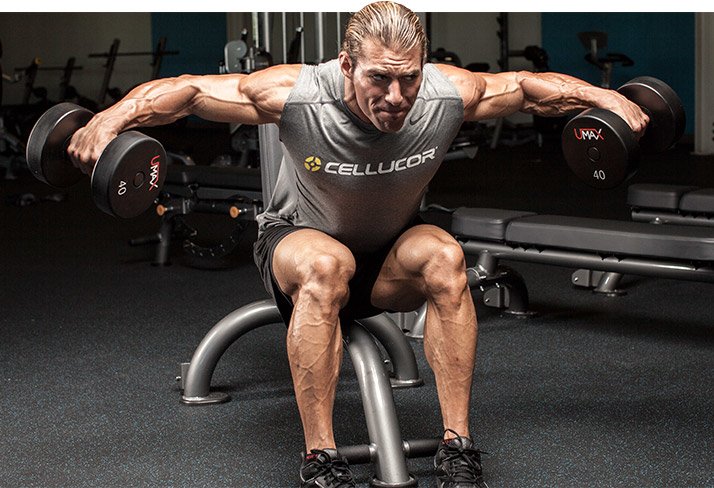
I'd like to say this is a mistake only beginners make, but it's commonly done wrong among intermediate lifters, as well. I've preached over and over again about the importance of keeping your arms locked in a slightly bent position when doing single-joint exercises like lateral raises, front raises, and bent-over lateral raises, regardless of the type of equipment you're using.
Dumbbell lateral raises

Once you start closing and opening up at the elbows, the triceps become part of the equation, reducing the effectiveness of the isolation you're trying to achieve with single-joint delt exercises. On movements like lateral raises and reverse standing cable flyes, many lifters mistakenly completely extend their elbows to 180 degrees at the end of the movement, then close them to about 90 degrees as they lower the weights. Using a weight that's too heavy is oftentimes the culprit.
If you're extending your elbows on shoulder exercises, congratulations: You now have a terrific triceps move. Too bad it's shoulder day!
While we're focusing on elbow extension here, it's worth noting that you don't want to fully lock out your elbow joints as you complete the move from start to finish, which puts pressure on the joint itself. Lock a very slight bend in your elbows that you hold throughout the range of motion.
7

Never leave rear delts for last in your workout

Your delts comprise three heads: the front, middle, and posterior. Some guys actually train them in that order because that's what they see looking back at them in the mirror, and that's usually a big mistake.
Guys who focus on building a big chest may have well-developed anterior deltoids (which contribute in all chest-pressing motions), but they could be lacking strong overall development.
If you've neglected back training, your rear delts are probably small in comparison to your front and middle delts, which sets you up for possible rotator-cuff complications down the road. It may also cause your shoulders to pull noticeably forward, giving you a slouched appearance.
If you've got a lagging area—which for most lifters is the rear delts—more often than not, do single-joint moves for that area first (after your presses) when your energy levels are highest, or consider doing a second single-joint movement for that area.
If your delts are fairly evenly developed, you can rotate the order in which you train them from one workout to the next, to ensure balanced development. If you always do one area last in your workout, however, it will begin to lag behind the others over time.
If your delts are fairly evenly developed, you can rotate the order in which you train them from one workout to the next, to ensure balanced development.
8

Never put off rotator-cuff training

Training is exhausting, let alone spending extra time on muscles you can't see and stretches that don't pack on size. That's why rotator-cuff training is at the bottom of everyone's list. But the rotators—a group of four strap muscles that work in coordination with the delts—help stabilize the shoulder joint.
When you train your delts—and chest, for that matter—but skip your rotators, the ratio of the strength between the two muscle groups can become imbalanced, and that increases your risk of a rotator-cuff injury. Any longtime lifter will tell you the importance of healthy rotator cuffs.
It isn't exactly sexy, but doing internal and external rotation exercises can keep your shoulders healthy for the long-haul.
9

Never train shoulders the day after chest

The shoulders, especially the anterior delts, are commonly recruited in chest movements, and your triceps assist in overhead pressing motions, so how you arrange your training split is important.
If you train chest and/or triceps the same day as delts, you're fine. If not, it's wise to insert at least two days before or after your chest day to ensure you don't overuse your delts. For example, don't train chest on Mondays, shoulders on Tuesdays, and triceps on Wednesdays. Insert pull-day workouts (back or biceps), legs, or rest days to allow ample recovery time for muscle recovery.